REVIEW on Sunscreen Filter Evaluation Criteria
Introduction
Not all UV filters share the same safety profile, systemic absorption characteristics, environmental impact, or endocrine-related evidence.
This classification is not intended to suggest that an approved UV filter is "illegal" or necessarily dangerous. Rather, it aims to rank filters according to more stringent formulation criteria:
Low systemic absorption
Low environmental concern
Absence of relevant endocrine-disruption signals
Greater compatibility with a conscious and precautionary approach to cosmetic formulation
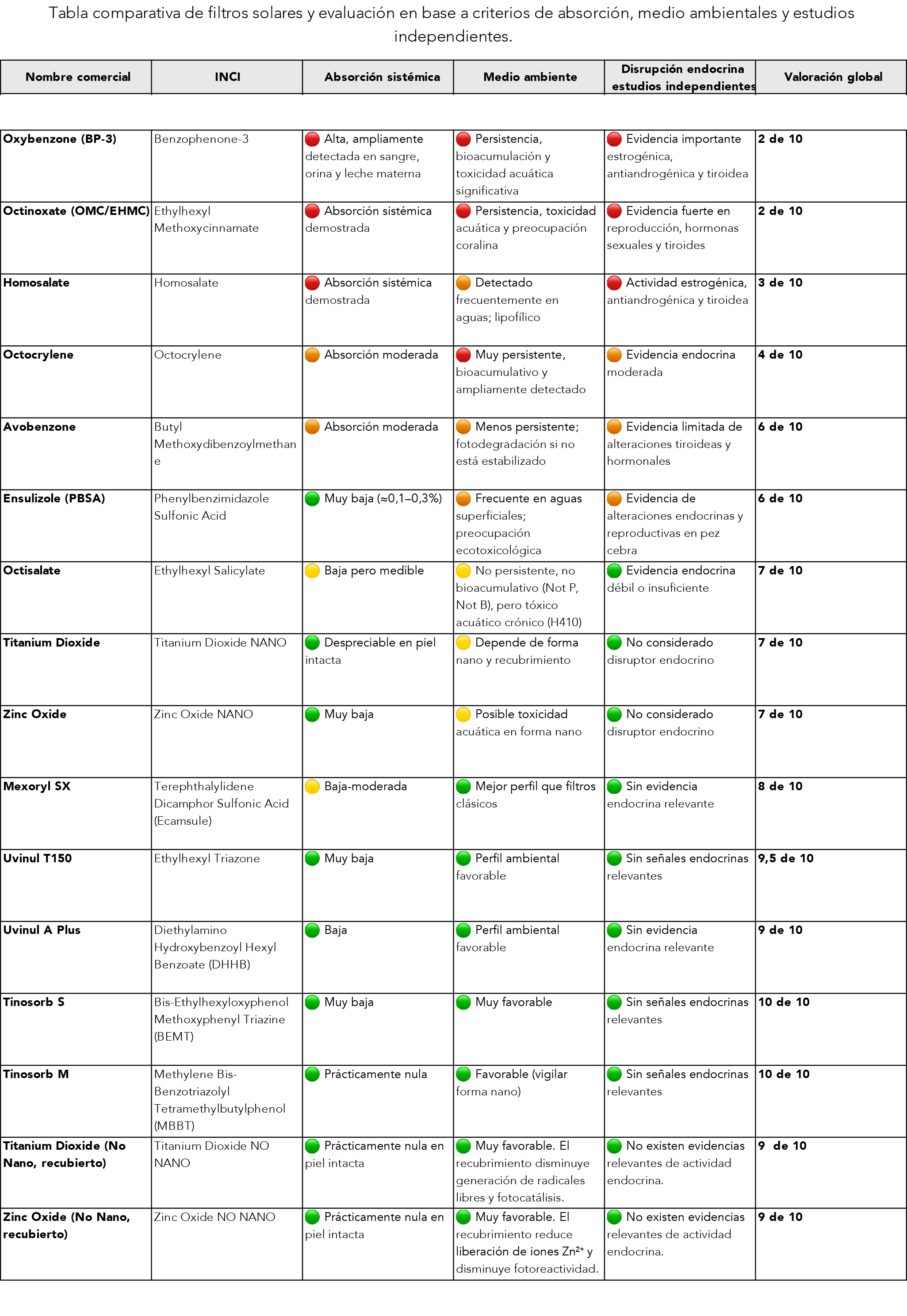
The evaluation is based on three main criteria:
1. Systemic Absorption
Whether the UV filter penetrates the skin and can be detected in blood, urine, breast milk, or other biological fluids.
2. Environmental Impact
Persistence, bioaccumulation, aquatic toxicity, and occurrence in water bodies, sediments, or wildlife.
3. Endocrine Disruption
Evidence from in vitro studies, animal studies, aquatic organisms, or observational human studies.
This is my Ranking:
Ingredient-by-Ingredient Analysis
1. 4-MBC — 4-Methylbenzylidene Camphor
Rating: 2/10
4-MBC is one of the most controversial legacy UV filters. Its main concern is not only systemic absorption but also evidence suggesting endocrine activity. It has been studied for its estrogenic potential and possible effects on hormonal systems, particularly in experimental models.
For this reason, although it has historically been used in sunscreens, it no longer fits within a modern, precautionary formulation philosophy focused on minimizing endocrine concerns.
Conclusion: Legacy filter, controversial, and not recommended.
2. Oxybenzone (BP-3) — Benzophenone-3
Rating: 2/10
Oxybenzone is one of the most problematic UV filters currently available. Systemic absorption has been clearly demonstrated, and the substance has been detected in blood, urine, and breast milk.
FDA/JAMA absorption studies showed that several traditional UV filters, including oxybenzone, reached measurable plasma concentrations following sunscreen application under maximal-use conditions.
From an environmental perspective, oxybenzone is frequently detected in water, sediments, and aquatic organisms. It has also been studied for its bioaccumulative potential and possible impacts on marine ecosystems.
Regarding endocrine disruption, studies have reported estrogenic, anti-androgenic, thyroid-related, and reproductive signals.
Conclusion: High-concern filter. It should be avoided in a stringent formulation approach.
3. Octinoxate (OMC/EHMC) — Ethylhexyl Methoxycinnamate
Rating: 2/10
Octinoxate is one of the UV filters with the strongest body of evidence suggesting endocrine-related concerns.
Systemic absorption has been demonstrated and was also documented in FDA/JAMA absorption studies.
Environmentally, it has been detected in water systems and is associated with aquatic toxicity and concerns regarding marine organisms.
Several reviews report repeated findings involving alterations in sex hormones, reproductive function, and thyroid-related pathways in experimental models and aquatic organisms.
Reproductive effects, hormonal alterations, and impacts on gonadal development have been observed in fish and other aquatic species.
Conclusion: A filter I would avoid, particularly in products intended for children, frequent use, or low-impact environmental philosophies.
4. Homosalate
Rating: 3/10
Homosalate has demonstrated systemic absorption and was included in FDA/JAMA absorption studies.
Its main concern is endocrine-related. The scientific literature describes estrogenic, anti-androgenic, and possible thyroid-disrupting activity in experimental models.
Its lipophilic nature also favors environmental presence and potential accumulation in biological compartments.
In recent years it has been subject to increased regulatory scrutiny due to safety-margin concerns and possible hormonal effects.
Conclusion: Although still widely used, it would not be a priority filter in a modern formulation. Better alternatives exist.
5. Octocrylene
Rating: 4/10
Octocrylene shows moderate systemic absorption and may persist longer in the body than some other UV filters.
Its primary concern is environmental. It is persistent, bioaccumulative, and widely detected in water, sediments, and aquatic organisms.
The endocrine evidence is weaker than that associated with octinoxate or oxybenzone but cannot be considered absent.
Some observational studies have explored associations with reproductive parameters, although human evidence remains insufficient to establish causality.
Conclusion: Not among the most concerning filters from a human toxicology perspective, but environmentally unattractive.
6. Avobenzone — Butyl Methoxydibenzoylmethane
Rating: 6/10
Avobenzone is a classic UVA filter. Systemic absorption is measurable but generally considered less concerning than oxybenzone, homosalate, or octinoxate.
Its main technical weakness is photoinstability, requiring appropriate stabilization within the formulation.
Regarding endocrine disruption, available reviews describe limited experimental signals, including anti-androgenic and possible thyroid-related effects, although the evidence is substantially weaker than for octinoxate or homosalate.
Conclusion: Not ideal, but an acceptable intermediate filter when necessary and properly stabilized.
7. Ensulizole (PBSA) — Phenylbenzimidazole Sulfonic Acid
Rating: 6/10
Ensulizole exhibits a relatively reassuring human safety profile regarding systemic absorption. It is water-soluble and demonstrates low dermal penetration.
Its main concern arises from ecotoxicology rather than human toxicology.
A zebrafish life-cycle study reported alterations in the endocrine reproductive system, reduced egg production, decreased fertilization rates, and transgenerational effects.
Researchers also reported interactions with zebrafish estrogen receptors, suggesting xenoestrogenic behavior in that aquatic model.
This does not constitute evidence of endocrine disruption in humans.
The distinction is important: the concern is primarily ecotoxicological rather than human toxicological.
Conclusion: Less concerning for humans, but environmental questions remain. An intermediate filter that may be used if necessary but would not be among my first choices.
8. Octisalate — Ethylhexyl Salicylate
Rating: 7/10
Octisalate exhibits low but measurable systemic absorption and was included in FDA/JAMA absorption studies.
Its environmental profile is generally better than that of octocrylene.
It is important not to confuse "chronic aquatic toxicity" with "persistence and bioaccumulation." While octisalate may be classified as toxic to aquatic organisms, current evaluations generally consider it neither persistent nor bioaccumulative.
Endocrine evidence remains weak or insufficient.
Conclusion: Acceptable with caution. Not perfect, but clearly preferable to oxybenzone, octinoxate, homosalate, or octocrylene.
9. Titanium Dioxide (Nano)
Rating: 7/10
Titanium dioxide is a mineral UV filter with negligible systemic absorption when applied to intact skin.
It is not considered an endocrine disruptor.
The main consideration relates to the nano form. Nanoparticles may present greater environmental interactions, particularly if inadequately coated.
Titanium dioxide may also exhibit photocatalytic activity if improperly treated, potentially generating free radicals under UV exposure.
Conclusion: Good from a systemic and endocrine perspective, although nano forms require careful assessment of particle size, coating technology, and intended use. Inhalable formats should be avoided.
10. Zinc Oxide (Nano)
Rating: 7/10
Zinc oxide demonstrates very low systemic absorption through intact skin and is not considered an endocrine disruptor.
The primary concern relates to environmental impact when used in nano forms or forms capable of releasing zinc ions.
Depending on concentration, solubility, and coating, zinc may be toxic to aquatic organisms.
Conclusion: A good mineral UV filter, although coated non-nano versions are preferable.
11. Mexoryl SX (Ecamsule)
Rating: 8/10
Mexoryl SX is a modern water-soluble UVA filter with a significantly improved profile compared with many traditional filters.
Its absorption may be low to moderate, but it is not considered among the most concerning endocrine-related UV filters.
It also lacks the environmental concerns commonly associated with oxybenzone, octinoxate, or octocrylene.
Conclusion: A very acceptable filter that can contribute positively to a well-designed sunscreen formula.
12. Uvinul T150 — Ethylhexyl Triazone
Rating: 9.5/10
Uvinul T150 is one of the most interesting modern UVB filters.
Its large molecular structure contributes to extremely low systemic absorption, and it does not appear among priority endocrine-disruption concerns.
Its environmental profile is more favorable than that of traditional UV filters, while its UVB efficacy is exceptionally high.
Conclusion: Excellent option and highly aligned with modern formulation principles.
13. Uvinul A Plus (DHHB)
Rating: 9/10
Uvinul A Plus is a modern, photostable UVA filter with low systemic absorption.
No relevant endocrine-disruption signals comparable to those of oxybenzone, octinoxate, or homosalate have been identified.
Current attention focuses primarily on manufacturing impurities rather than the UV filter molecule itself.
Conclusion: Very good option when sourced from manufacturers with appropriate impurity control.
14. Tinosorb S (BEMT)
Rating: 10/10
Tinosorb S is one of the best modern UV filters available.
It offers broad-spectrum protection, excellent photostability, very low systemic absorption, and no relevant endocrine-disruption signals.
Its large, lipophilic structure significantly limits skin penetration.
Conclusion: One of the best UV filters currently available.
15. Tinosorb M (MBBT)
Rating: 10/10
Tinosorb M is a hybrid UV filter acting through both absorption and scattering/reflection mechanisms.
Systemic absorption is virtually negligible.
The SCCS concluded that the overall weight of evidence indicates extremely low absorption through both intact and damaged skin.
Conclusion: Excellent option and highly compatible with a low-systemic-absorption formulation philosophy.
16. Titanium Dioxide (Non-Nano, Coated)
Rating: 9/10
Non-nano coated titanium dioxide significantly improves upon untreated nano forms.
The non-nano structure reduces concerns regarding nanoparticle behavior, while coatings reduce photocatalysis and free-radical generation.
Systemic absorption is virtually nonexistent through intact skin.
Conclusion: Excellent mineral filter when properly coated and not used in inhalable formats.
17. Zinc Oxide (Non-Nano, Coated)
Rating: 9/10
Non-nano coated zinc oxide is one of the best mineral UV filter options available.
The non-nano form reduces environmental concerns associated with nanoparticles, while coatings reduce zinc-ion release and photoreactivity.
No relevant endocrine-disruption evidence has been identified.
Conclusion: Excellent option, particularly for sensitive skin, children's products, and formulations prioritizing minimal systemic absorption.
Positive List: Preferred UV Filters
Tinosorb S (BEMT)
Tinosorb M (MBBT)
Uvinul T150 (Ethylhexyl Triazone)
Uvinul A Plus (DHHB)
Non-Nano Coated Zinc Oxide
Non-Nano Coated Titanium Dioxide
Mexoryl SX (Ecamsule)
These filters combine low systemic absorption, favorable environmental profiles, and the absence of relevant endocrine-related signals.
Intermediate Filters
These would not be my first choice but may be acceptable when necessary to achieve adequate UV coverage, texture, or formulation stability:
Octisalate
Ensulizole (PBSA)
Avobenzone
Negative List: UV Filters I Would Avoid
Oxybenzone (BP-3)
Octinoxate (OMC / EHMC)
Homosalate
Octocrylene
4-MBC
PABA and derivatives
These filters concentrate the greatest concerns regarding systemic absorption, environmental persistence, bioaccumulation, aquatic toxicity, or endocrine-related signals.
Final Conclusion
An ideal sunscreen formula, according to these criteria, should prioritize modern UV filters with low systemic absorption and a low level of environmental and endocrine-related controversy.
Intermediate filters may be used when necessary, but should not constitute the foundation of a formula when better-evaluated alternatives are available.
Important Notice and Personal Formulation Philosophy
This classification reflects exclusively my personal criteria as a cosmetic formulator, skin coach, and product developer.
It is not intended to replace, challenge, or contradict evaluations conducted by regulatory authorities, including the European Union, SCCS, ECHA, AEMPS, the FDA, or any other national or international regulatory body.
All UV filters authorized within the European Union have undergone regulatory assessment and may be legally used within established concentration limits and conditions of use.
The evaluations presented here do not constitute a declaration that any ingredient is either safe or unsafe, nor do they imply that an authorized product necessarily represents a risk to human health.
The scores assigned are based on personal criteria prioritizing:
Low systemic absorption
Lower environmental concern
Lower evidence of endocrine activity in experimental studies
Greater photostability
Preference for modern UV filters with more favorable toxicological profiles
Many of the studies referenced involve in vitro research, animal studies, or ecotoxicological investigations in aquatic organisms. The existence of such studies does not automatically imply that the same effects occur in humans under normal conditions of use.
It is also important to distinguish between:
Evidence observed in cell cultures
Evidence observed in laboratory animals
Evidence observed in aquatic organisms
Observational associations in humans
Demonstrated causal relationships in humans
These categories represent very different levels of evidence and should be interpreted with caution.
The conclusions expressed in this document represent solely my professional opinion and the decisions I would personally make when formulating cosmetic products for my brand, my family, and my own children, applying a level of precaution beyond that required by current regulations.
Other formulators, toxicologists, dermatologists, scientists, or regulatory authorities may legitimately reach different conclusions based on the same available scientific data.
This document is intended exclusively for informational, educational, and scientific discussion purposes and does not constitute medical, toxicological, legal, or regulatory advice.
Paola Gugliotta
Cosmetic Formulator · Skin Coach
MBA, ESADE Business School
Master's Degree in Pharmaceutical Dermocosmetics – University of Barcelona
Harvard Medical School HMX – Genetics & Immunology
Founder of SEPAI and The Today Project