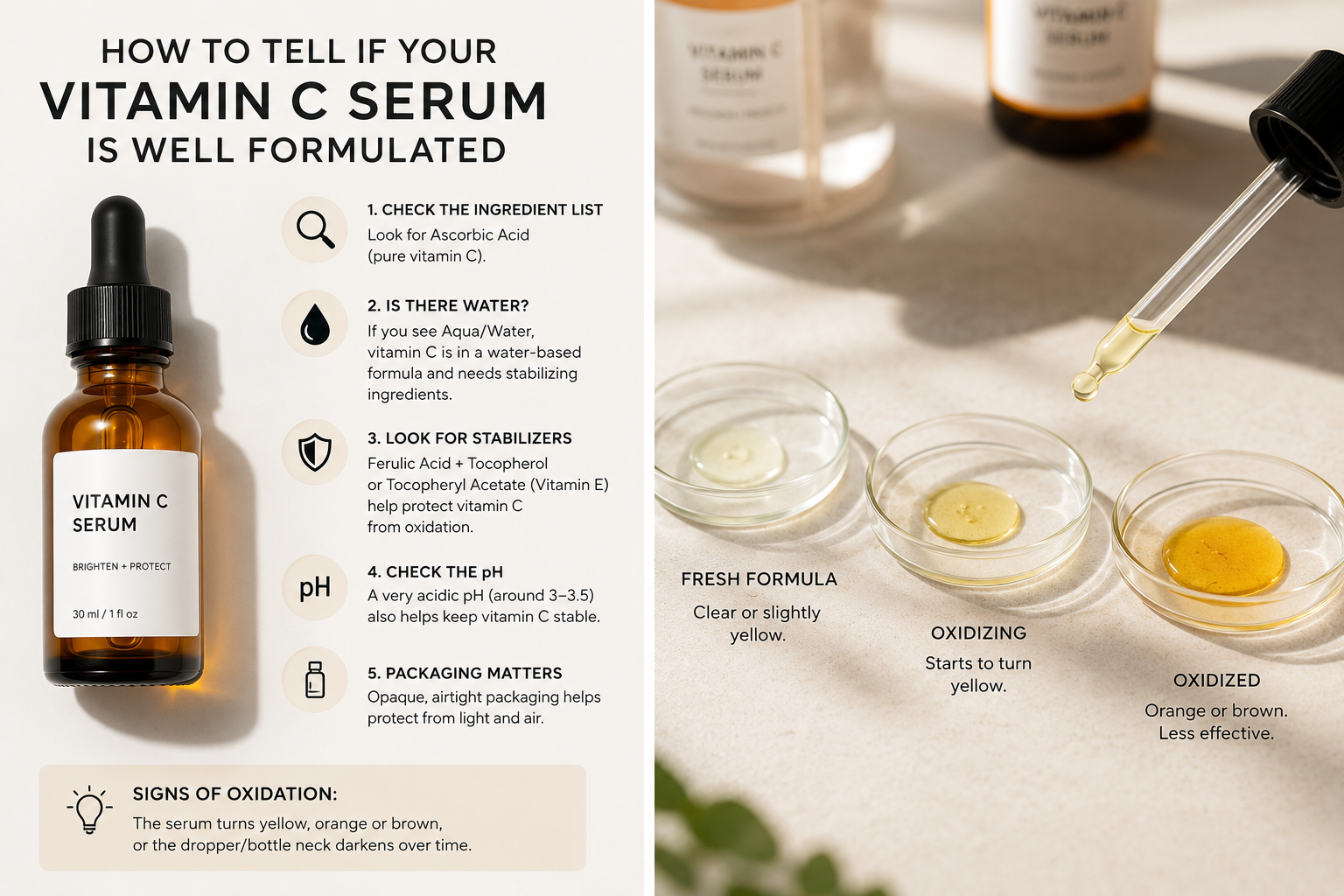
How to Tell If Your Vitamin C Serum Is Well Formulated
There are many different forms of vitamin C, and surprisingly, I've seen a lot of vitamin C serums that aren't formulated very well.
Here's exactly what to look for.
Why Formula Matters More Than the Vitamin C Percentage
First, check the ingredient list and look for Ascorbic Acid.
Pure Vitamin C (Ascorbic Acid): Powerful but Unstable
If you find it, that's pure vitamin C—the form with the strongest scientific evidence, but also the least stable.
Now look for Aqua or Water.
If you see both Ascorbic Acid and Water, pure vitamin C is dissolved in water, which makes it much more prone to oxidation.
What should you look for next?
One of the best-known stabilization systems combines:
Ferulic Acid
Tocopherol or Tocopheryl Acetate (vitamin E)
These ingredients help protect vitamin C from oxidation and improve its stability.
If these ingredients are not present, another possibility is that the formula has been developed with a very acidic pH (around 3–3.5) .
How to Recognize an Oxidized Vitamin C Serum?
It starts out clear or pale yellow but gradually turns yellow, orange, or brown.
The serum darkens after only a few weeks.
The neck of the bottle or the dropper becomes noticeably darker.
These are signs that the vitamin C is oxidizing, meaning less active vitamin C remains in the product.
On the other hand, if the formula doesn't contain water (an anhydrous formula), pure ascorbic acid is generally much more stable.
Stable Forms of Vitamin C You Can Trust.
There's also another option: instead of pure vitamin C, many products use stable vitamin C derivatives.
If you see any of these names, you're looking at forms that are naturally much more stable:
3-O-Ethyl Ascorbic Acid
Ascorbyl Glucoside
Magnesium Ascorbyl Phosphate
Sodium Ascorbyl Phosphate
Tetrahexyldecyl Ascorbate
Ascorbyl Tetraisopalmitate
Ascorbyl Palmitate
Aminopropyl Ascorbyl Phosphate
Among these, Tetrahexyldecyl Ascorbate and Ascorbyl Tetraisopalmitate are particularly interesting because they are oil-soluble, exceptionally stable, penetrate the skin very well, and are widely considered among the most elegant forms of vitamin C used in premium skincare formulations.
A good vitamin C serum isn't just about having vitamin C on the label. It's about having a formula that keeps it stable, active, and effective until the last drop.
Which Vitamin C Serum Is Right for Your Skin?
At The Today Project, we believe that great skincare isn't just about adding one trendy ingredient—it's about creating balanced, scientifically designed formulas where every ingredient works together.
That's why we offer two vitamin C serums, both formulated with stable vitamin C alongside complementary ingredients that help support healthy skin.
HYAL+C Face Serum – Ideal for oily, combination, or men's skin, with a lightweight texture that hydrates, protects against oxidative stress, and strengthens the skin barrier.
RESURFACING Glow Face Serum – Perfect for combination skin as a complete treatment serum, or for normal to dry skin used underneath your moisturizer. It combines stabilized vitamin C with hydrating, barrier-supporting, and biomimetic ingredients to promote smoother, brighter, healthier-looking skin.
Because in the end, the best vitamin C isn't the one with the highest percentage—it's the one that remains stable, active, and is supported by the right ingredients until the very last drop.