For years, hotel amenities followed a simple model: buy, place, partially consume, replace and discard.
But what looks like a small cost per room becomes a significant operational expense when multiplied by hundreds of rooms, thousands of stays and an entire year of hotel operations.
Refillable hotel amenities can reduce costs because they change what the hotel repeatedly pays for. Instead of purchasing a new bottle, closure, label and product every time an amenity needs replacing, a refill system allows the permanent dispenser to remain in the room while primarily replacing what has actually been consumed: the product itself.
At The Today Project, this is the principle behind our approach to Luxury Refillable Hotel Amenities: reducing unnecessary packaging and operational complexity without reducing the quality of the guest experience.
The real cost of hotel amenities goes beyond the formula
When comparing single-use or small-format amenities with refillable systems, looking only at the purchase price of each unit can be misleading.
Every individual amenity involves more than the cosmetic formula inside it.
The hotel is also purchasing packaging, closures, decoration and labels. Those units need to be transported, received, stored, moved through the hotel, placed in guest rooms, replaced by housekeeping and eventually managed as waste.
Individually, these costs may seem insignificant.
Across a hotel operation, they accumulate.
A refillable system changes the equation by separating the permanent packaging from the consumable product.
The dispenser becomes part of the room. The product is replenished from larger professional refill formats.
In other words, the hotel can progressively move from repeatedly buying product + packaging to primarily replenishing product.
1. Refillable amenities reduce packaging costs
This is perhaps the most immediate economic advantage.
With conventional miniature amenities, every new unit requires a new bottle or tube, cap, label and secondary packaging where applicable.
Much of that packaging has an extremely short useful life.
With refillable hotel amenities, the main dispenser can remain in service through many guest stays.
Its initial cost is therefore distributed over a much longer period.
The longer a well-designed dispenser remains in circulation, the lower its packaging cost becomes per stay and per guest.
This is why refill should not be evaluated simply by comparing the price of one miniature bottle with the price of one refillable dispenser.
The more meaningful question is:
What does it cost to provide shampoo, shower gel, conditioner or body lotion to one hotel room over an entire year?
That is where the economics of refill become much more interesting.
2. Hotels can reduce product waste
There is another cost hidden inside traditional amenity systems: unused product.
A guest may open a small shampoo or shower gel and use only part of its contents. Depending on the format and the hotel's operating procedures, some of the remaining product may ultimately be discarded.
A refillable dispenser works differently.
The product that has not been consumed remains available.
Housekeeping replenishes according to consumption rather than automatically replacing an entire individual unit.
A few millilitres may not seem financially relevant.
Multiply those millilitres across rooms, occupancy levels and 365 days of operation, and product waste becomes an operational variable worth considering.
3. Fewer individual units can simplify hotel logistics
Cost reduction is not only about the price paid to the cosmetics supplier.
There is also a cost associated with complexity.
Thousands of individual amenities require purchasing, receiving, counting, storing, moving and replenishing thousands of individual units.
Refill systems can significantly reduce the number of pieces moving through that chain.
Larger professional refill formats consolidate product supply and can reduce the amount of individual packaging that needs to enter the hotel.
This can mean:
fewer individual units to purchase, fewer boxes to handle, less packaging to store and less waste to remove from guest rooms.
For purchasing, operations and housekeeping teams, that simplification matters.
4. Refill can make housekeeping more efficient
A refillable amenity system should never be designed solely around the bottle the guest sees.
The invisible part of the system is equally important.
How quickly can housekeeping check the product level? How easily can the dispenser be replenished? What refill size makes sense for the property? How frequently will stock need to move from storage to the floors?
At The Today Project, we believe the room dispenser and the back-of-house refill format should be considered as one system.
A beautiful dispenser that creates unnecessary operational work is not good design.
The objective is to balance aesthetics, guest experience and operational efficiency.
5. Less waste also means less waste to manage
Reducing packaging has a second economic consequence: there is simply less material for the hotel to handle after use.
Every disposable container has to go somewhere.
It must be collected from the room, moved through the hotel's waste stream and eventually processed as waste.
A permanent refillable dispenser can replace a large number of short-lived individual containers during its useful life.
This is where environmental and economic efficiency begin to overlap.
Using less material can mean buying less material, transporting less material, storing less material and ultimately disposing of less material.
For us, these are not separate conversations.
They are different consequences of designing the system more intelligently.
6. Refillable does not have to mean generic
One of the historical objections to dispensers in luxury hospitality has been perception.
Can refillable amenities still feel luxurious?
We believe the answer depends entirely on how they are designed.
Luxury is not determined by how quickly an object is discarded.
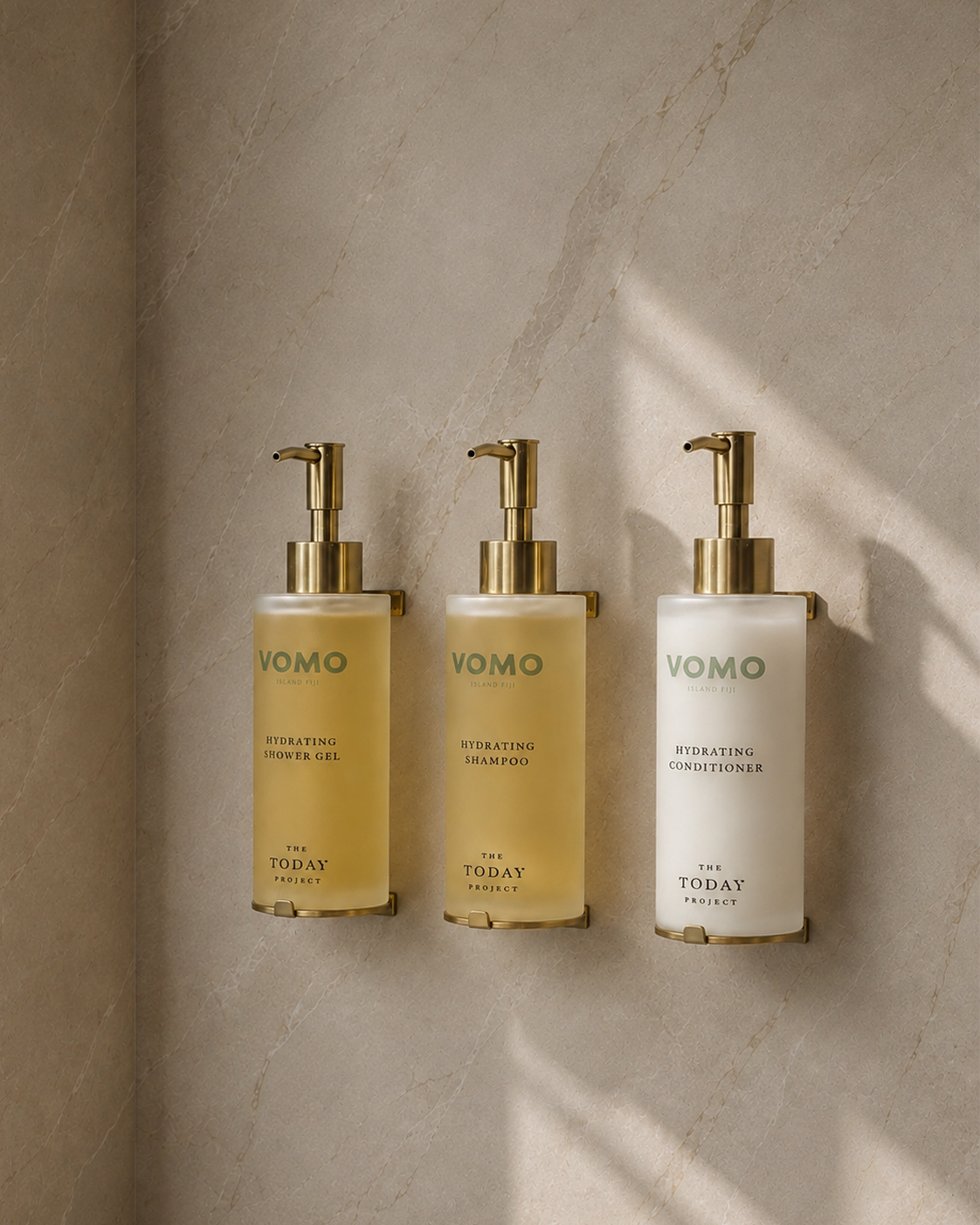
A permanent aluminium or resin dispenser can become part of the architecture of the bathroom rather than an object temporarily placed on a vanity.
The formula, texture, fragrance, typography, materials and way the product interacts with the space all contribute to perceived quality.
At The Today Project, our approach is not to make sustainability visible at the expense of luxury.
It is to make better design eliminate unnecessary waste.
7. The amenity can become part of the hotel's identity
There is another potential return that is harder to calculate on a spreadsheet: memory.
When the same generic amenity appears in multiple hotels, it contributes very little to the identity of the property.
But fragrance has an extraordinary ability to create associations with places and experiences.
A hotel's shampoo, shower gel, hand wash or body lotion can therefore do more than fulfil a functional requirement.
It can become part of its olfactory identity.
For selected projects, The Today Project can develop amenity systems in which fragrance, cosmetic products and other scented touchpoints speak the same language.
The experience in the bathroom can connect with the atmosphere of the room, the lobby or even a product that the guest can later take home.
The amenity stops being merely a consumable.
It becomes part of the memory of the stay.
8. The right comparison is annual cost per occupied room
There is an important distinction to make.
Moving to refillable amenities can require a greater initial investment because permanent dispensers are designed to remain in use rather than be discarded.
For that reason, evaluating refill purely on initial purchase price can produce the wrong conclusion.
Hotels should instead consider the system over time.
That means analysing factors such as:
annual product consumption;
cost of permanent dispensers over their useful life;
refill cost;
packaging consumption;
product waste;
storage and internal handling;
replacement rates;
waste generation.
The exact saving will naturally vary according to the size of the hotel, occupancy, guest behaviour, existing amenity format and operational model.
There is no credible universal percentage that applies to every property.
But the economic principle is straightforward:
the more times packaging can be reused, the less frequently the hotel needs to pay for that packaging again.
Refill & Less Waste by Design
At The Today Project, refill is not an accessory added to a conventional cosmetic product after it has been developed.
It is part of the design brief from the beginning.
We call this approach Refill & Less Waste by Design.
We consider the cosmetic formula, permanent dispenser, refill format, expected consumption and hotel operation as interconnected parts of the same system.
The aim is not simply to replace a 30 ml bottle with a 300 ml bottle.
It is to rethink how luxury hotel amenities are supplied and consumed.
Less unnecessary packaging.
Less product waste.
Fewer individual units to purchase and handle.
A more rational refill operation.
And a guest experience that still feels considered, sensorial and unmistakably premium.
Because reducing costs does not have to mean reducing quality.
Sometimes it simply means eliminating what you never needed to keep buying in the first place.
Discover The Today Project Luxury Refillable Hotel Amenities
From our existing cosmetic formulas and fragrance collection to bespoke packaging and olfactory identity projects, The Today Project develops refillable amenity solutions designed around the needs of each property.
Discover our Luxury Refillable Hotel Amenities →